Introduction
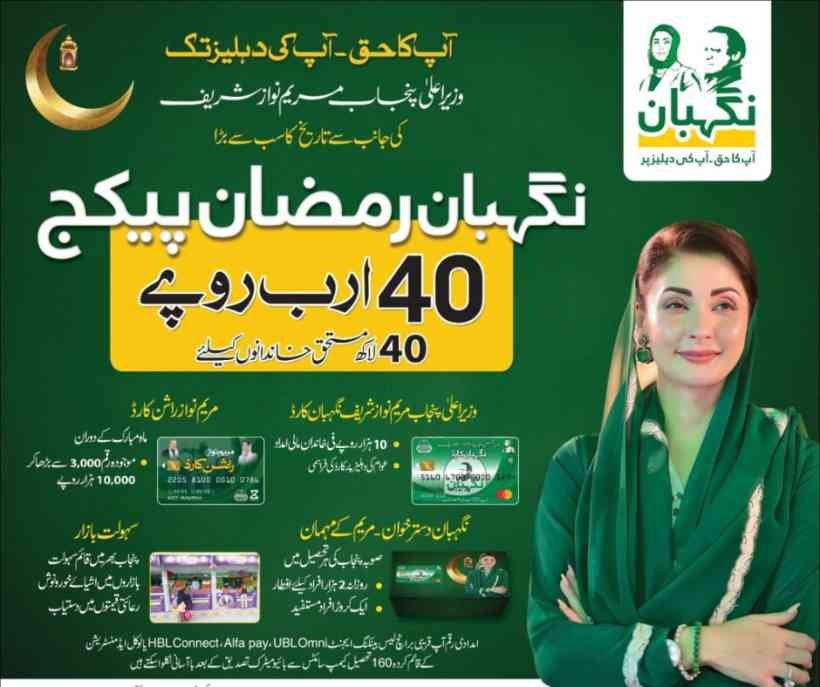
In the spirit of compassion and social welfare that defines the holy month of Ramadan, the Government of Punjab, under the leadership of Chief Minister Maryam Nawaz Sharif, has launched the Ramzan Nigheban Package 2026. This initiative, also known as the Ramadan Nigheban Package or Nigehban Ramzan Package, aims to provide essential financial relief to low-income and deserving families across Punjab during Ramadan 1447 Hijri (approximately February 16 to March 17, 2026). With inflation and economic pressures affecting millions, this program stands as a beacon of support, ensuring that vulnerable households can observe the sacred month with dignity and without undue hardship. The package is a flagship welfare scheme that builds on previous efforts, emphasizing transparency, efficiency, and direct assistance to those in need.
Named “Nigheban,” which translates to “guardian” or “caretaker” in Urdu, the program reflects the government’s role in safeguarding the well-being of its citizens. It is distinct from the federal Prime Minister’s Ramzan Relief Package (which offers Rs. 13,000 to eligible families nationwide via the 9999 helpline), focusing specifically on Punjab residents. For 2026, the Punjab government has allocated a substantial budget of Rs. 47 billion to benefit approximately 4.2 million families, making it one of the largest provincial relief efforts in recent years.
This article provides a detailed exploration of the Ramzan Nigheban Package 2026, covering its background, key features, eligibility requirements, application process, distribution mechanisms, and overall impact. Whether you’re a potential beneficiary or simply interested in Pakistan’s social welfare landscape, this guide offers comprehensive insights tailored to the Pakistani context, with a focus on Punjab.
Background and Evolution of the Program
The Ramzan Nigheban Package traces its roots to earlier relief initiatives introduced by the Punjab government to combat poverty and food insecurity during Ramadan. First prominently launched in 2024 under Maryam Nawaz’s administration, the program has evolved to incorporate digital tools and data-driven targeting to minimize corruption and ensure equitable distribution. By 2026, it has been refined based on feedback from previous years, with enhancements in eligibility verification and payment systems.
Chief Minister Maryam Nawaz Sharif, daughter of former Prime Minister Nawaz Sharif and a key figure in the Pakistan Muslim League-Nawaz (PML-N), has positioned this package as part of her broader vision for inclusive governance. Launched in late January 2026, the program aligns with national efforts to support the underprivileged during religious observances, but it stands out for its provincial scale and focus on cash-based aid rather than solely ration distribution. The initiative draws from the Punjab Socio-Economic Registry (PSER), a centralized database established to identify and assist low-income households across various welfare schemes.
In the context of Pakistan’s economic challenges— including high inflation rates hovering around 10-15% in 2026 and persistent poverty affecting over 40% of the population in rural Punjab—this package serves as a critical safety net. It not only addresses immediate needs but also promotes financial inclusion by integrating beneficiaries into digital payment systems.
Key Features and Benefits of the Package
The Ramzan Nigheban Package 2026 is multifaceted, offering more than just financial aid. Here’s a breakdown of its core components:
- Cash Assistance: The primary benefit is a one-time cash transfer of Rs. 10,000 per eligible household. This amount is intended to cover essential expenses like food, utilities, and other necessities during Ramadan.
- Subsidized Ration and Discounts: In addition to cash, beneficiaries may access subsidized essential items through mobile ration vans deployed across Punjab. The Nigheban Card also provides a 10% discount on groceries and staples at designated utility stores and markets.
- Digital Integration: Funds are disbursed via the Ramzan Nigheban ATM Card or direct bank transfers, ensuring transparency and reducing the risk of intermediaries. This digital approach aligns with Pakistan’s push towards a cashless economy.
- Additional Support: Priority is given to vulnerable groups, including widows, orphans, the elderly, and persons with disabilities. Some districts may include supplementary items like flour, sugar, ghee, and rice in the package.
The program is designed to reach urban and rural areas alike, with special emphasis on underserved regions in southern Punjab, such as Multan, Bahawalpur, and Dera Ghazi Khan.
Eligibility Criteria: Who Qualifies?
Eligibility for the Ramzan Nigheban Package 2026 is strictly data-driven, relying on the PSER to avoid favoritism. To qualify, households must meet the following criteria:
- Residency: Must be permanent residents of Punjab province. Non-residents or those from other provinces (e.g., Sindh, Khyber Pakhtunkhwa, or Balochistan) are ineligible, though they may apply for federal programs.
- Income Level: Household monthly income should generally be below Rs. 50,000 to Rs. 60,000. A Poverty Means Test (PMT) score below 32-34 is required, as determined by PSER surveys.
- Socio-Economic Status: Families registered in PSER with indicators of low socio-economic standing, such as limited assets, unemployment, or large family size, are prioritized.
- Vulnerable Categories: Special consideration for widows, disabled individuals, elderly citizens (above 60 years), and households headed by women.
- Exclusion Criteria: High-grade government employees, families with significant assets (e.g., multiple vehicles or properties), or those already receiving substantial aid from other programs may be disqualified.
Importantly, eligibility is not automatic; it requires verification through PSER data.
Requirements and Necessary Documents
To participate, applicants need minimal documentation, emphasizing accessibility:
- Valid CNIC: A 13-digit Computerized National Identity Card (CNIC) issued by NADRA is mandatory for the household head.
- PSER Registration: Proof of registration in the Punjab Socio-Economic Registry. If not registered, individuals must complete this step first.
- Household Details: Information on family members, income sources, and living conditions, which is collected during PSER registration.
No additional documents like utility bills or income certificates are typically required, as the government relies on PSER’s comprehensive database.
How to Apply or Register for the Package
The application process is straightforward and leverages both online and offline channels to accommodate all segments of society:
- Register in PSER (If Not Already Done):
- Online: Visit the official PSER portal at pser.punjab.gov.pk. Create an account using your CNIC, enter household details (e.g., family size, income, employment), and submit.
- Offline: Go to your nearest Union Council office or designated PSER center. Government representatives will assist with form filling and data entry. Bring your original CNIC.
- Automatic Consideration: Once registered in PSER, eligible households are automatically shortlisted based on socio-economic scores. No separate application for the Nigheban Package is needed.
- Key Dates: Registration opened in January 2026, with distributions starting from early February. The last date for updates is typically mid-February, but check official channels for extensions.
For assistance, call the dedicated helpline at 0800-02345, available from 9 AM to 5 PM.
How to Check Eligibility and Status
Checking your status is simple and free:
- SMS Method: Send your CNIC number (without dashes) to 8070. You’ll receive an instant response confirming eligibility.
- Online Portal: Visit pser.punjab.gov.pk or the official Punjab government website (punjab.gov.pk) and enter your CNIC to view your PSER status and package eligibility.
- Helpline: Dial 0800-02345 for personalized guidance.
If ineligible, you can appeal by updating your PSER data or contacting local authorities.
Distribution Process: How Benefits Are Delivered
Once approved, benefits are distributed efficiently:
- Cash Disbursement: Rs. 10,000 is transferred directly to the beneficiary’s bank account or via the Nigheban ATM Card, which can be activated at partnered banks like Habib Bank Limited (HBL) or United Bank Limited (UBL).
- Ration Delivery: Subsidized items are available through mobile vans or utility stores. Beneficiaries present their CNIC or Nigheban Card for access.
- Timeline: Distributions begin in the first week of Ramadan and continue throughout the month. In 2026, with Ramadan starting mid-February, early applicants received aid by late January.
The process is monitored by district administrations to ensure no delays or irregularities.
Impact and Significance in Pakistan
The Ramzan Nigheban Package 2026 has far-reaching implications for social equity in Punjab. By reaching 4.2 million families, it directly alleviates poverty for over 20 million individuals, assuming average household sizes. Economically, it injects billions into local markets, boosting small businesses during Ramadan.
Critics note challenges like data inaccuracies in PSER, but the program’s digital focus has reduced corruption compared to past schemes. Overall, it underscores Maryam Nawaz’s commitment to women-led governance and welfare, setting a model for other provinces.
In a country where Ramadan is a time of heightened charity, this government-backed initiative complements private efforts, fostering a more inclusive society.
Conclusion
The Maryam Nawaz Ramzan Nigheban Package 2026 exemplifies proactive governance in addressing economic vulnerabilities during a spiritually significant period. By meeting the outlined eligibility requirements and registering promptly, eligible Punjab residents can access vital support. For the latest updates, always refer to official sources like the Punjab government website or helpline. This program not only provides immediate relief but also builds long-term trust in public institutions, ensuring that no family in Punjab faces Ramadan alone.


